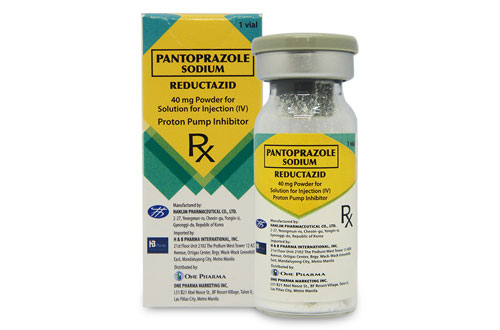
Pantoprazole Sodium
REDUCTAZID
FORMULATION
Each vial contains:
Pantoprazole (as sodium), USP………..40 mg
INDICATIONS:
Gastroesophageal reflux disease associated with a history of erosive esophagitis
Pantoprazole for injection is indicated for short-term treatment (7 to 10 days) of adult patients with gastroesophageal reflux disease (GERD) and a history of erosive esophagitis.
Safety and efficacy of pantoprazale for injection as treatment of patients with GERD and a history or erosive esophagitis for more than 10 daye have been demonstrated.
Pathological hypersecretion including Zollinger-Ellision Syndrome
Pantoprazole for injection is indicated for the treatment of pathological hypersecretory conditions including Zollinger-Ellision syndrome in adults.
DOSAGE AND ADMINISTRATION
Parenteral drug products should be inspected visually for particulate matter and discoloration prior to and during administration whenever solution and container permit.
Parenteral routes of administration other than intravenous are not recommended.
Pantoprazole for injection may be administered intravenously through a dedicated line or through a Y-site. The intravenous line should be flushed before and after administration of pantropazole for injection with either 5 % Dextrose injection, USP, 0.9% Sodium Chloride Injectionm USP, or Lactated Ringer’s Injection, USP. When administered through a Y-site, pantoprazole for injection is compatible with the following solutions: 5 % Dextrose Injection, USP, 0.9 % Sodium Chloride Injection, USP, or Lactated Ringer’s Injection, USP.
RECOMMENDED DOSAGE
The recommended adult dose is 40 mg pantoprazole given once daily by intravenous infusion for 7 to 10 days.
Administration and preparation instructions
Data on the safe and effective dosing for condition other than the described (see Indications and Usage) such as a life-threatening upper gastrointestinal bleeds, are not available, PANTOPRAZOLE 40 mg once daily does not raise gastric pH to levels sufficient to contribute to the treatment of such life-threatening conditions.
CONTRAINDICATIONS
Panoprazole is contraindicated in patients with known hypersensitivity reactions including anaphylaxis to the formulation or any substituted benzimidazole.
WARNING AND PRECAUTIONS
→ NATAVINGS & PRECAUTONS SPeCIAL FRECAUTONS
Implications of symptomatic response
Sympotomatic response to therapy with pantoprazole does not preclude the presence of gastric malignancy.
Hypersensitivity and severe skin reactions.
Anaphylaxis and other serious reactions such as erythema multiforme, Stevens-Johnson syndrome, and toxic epidermal necrolysis (TEN) have been reported with use of intravenous pantoprazole. These may require emergency medical treatment.
b
Thrombophlebitis was associated with administration of intravenous pantoprazole.
Clostridium difficile associated diarrhea
Published observational studies suggest that PPI therapy like pantoprazole maybe associated with an
Increased risk of Clostridium difficile associated diarrhea, especially in hospitalized patients. This diagnosis should be considered for diarrhea that does not improve.
Patients should use the lowest dose and shortest duration of PPI therapy appropriate to the condition
being treated.
Bone fracture
Several published observational studies suggest that proton pump inhibitor (PPI) therapy may be associated with an increased risk for osteoporosis-related fractures of the hip, wrist, or spine. The risk of fracture was increased in patients who received high-dose, defined as multiple daily doses and long-term PPI therapy (a year or longer). Patients should use the lowest dose and shortest duration of PPI therapy appropriate to the condition being treated. Patients at risk for osteoporosis-related fractures should be managed according to established treatment guidelines.
Hepatic effects
Mild, transient transaminase elevations have been observed in clinical studies. The clinical significance of this finding in a large population of subjects administered intravenous pantoprazole is unknown.
ADVERSE DRUG REACTIONS
Postmarketing experience
The following adverse reactions have been identified during post approval use of pantoprazole. Because these reactions have been reported voluntarily from a population of uncertain size. It is not always possible to reliably estimate their frequency or establish a casual relationship to drug exposure.
These adverse reactions are listed below by body system:
General disorders and administration conditions: asthenia, fatigue, malaise
Immune system disorders: anaphylaxis (including anaphylactic shock)
Investigations: weight changes
Skin and subcutaneous tissue disorders: severe dermatologic reactions (some fatal), including erythema multiforme, Stevens-Johnson syndrome, and toxic epidermal necrolysis (TEN), and angioedema (Quincke’s edema)
Musculoskeletal disorders: rhabdomyolysis, bone fracture
Renal and urinary disorders: interstitial nephritis
Hepatobiliary disorders: hepatocellular damage leading to jaundice and hepatic failure
Psychiatric disorder: hallucinations, confusion, insomnia, somnolence
Metabolism and nutritional disorders: hyponatremia, hypomagnesernia
Infections and infestations: Clostridium difficie associated diarrhea
Hematologic: pancytapenia,
agranulocylasis
Nervaus: egeusia, dyageusla
DRUG INTERACTIONS
→ INTENACTION
alazanavir
nelfinavir
inhibitors is not recommended.
Concomine
Coadministration
substantially
or elazanavir or
neifinavir
with proton pump inhibitors
expacted to
decrease atazanavir or neitinavir plasma concentrations and may result in a loss of therapeuc enect and develaomen of drug resistance.
Coumarin anticoagulants
rocen pump anibtor, inkeding pantoprazole and Mararn oncarmiand) Inoreeses in INF and
prothromain ume
may lead to abnormal bleeding and even death.
inhibitors and warfarin concomitantly should be monitored for increases in INR and prothrombin time.
Clopidogrel
Concomitant administration of pantoprazole and clopidogrel in healthy subjects had no clinically important
aniecon
metabolite of clopidogrel or clapidogral-induced platelet inhibition.
No
lose adjustment of clopidogel is necessary when administered with an approved dose of pantaprazole Drugs for which gastric pH can affect bioavailability. with absorption
ketoconazale, ampicilin estors, iron salts, and digoxin).
False positive urine test for THC
There have been reporte of false positive urine screaning test for tetrahydrocannabinol (THC) in patients receiving
proton pump inhibitors
including pantoprazole. An altemstive confirmatory metrod should be
considerad to verity positive results.
Methotrexate
Case reports,
published population
pharmacokinetlo studies,
and retrospective analyses suggest that
PPIS
methotrexate
(primarily
al high
ooat
sao
melhotro»ate
concomitantly
administration of
of methotrexate
metabolie
may elevate
prodroomotect meet a literation studies of methotrexats with PPis have been
conducted.
USE IN SPECIFIC POPULATIONS
Pregnancy
Teratoganic Effects
Pregnancy Category b
no adequate and wall-controlled studies in pregriant woren because animal reproduction
AVAILABILTY
USP Type | 10 ml clear glass vial (Box of 1’s)
For more information, please see full product information.