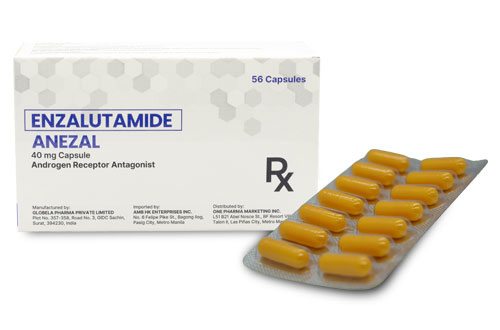
Enzalutamide
ANEZAL
RX
FORMULATION
Each capsule contains 40 mg Enzalutamide
Enzalutamide………. 40 mg
INDICATIONS
Enzalutamide is indicated for the treatment of patients with:
- castration-resistant prostate cancer (CRPC)
- metastatic castration-sensitive prostate cancer (mCSPC)
DOSAGE AND ROUTE OF ADMINISTRATION
Recommended Dosage
The recommended dosage of Enzalutamide is 160 mg administered orally once daily with or without food. Swallow capsules or tablets whole. Do not chew, dissolve, or open the capsules. Do not cut, crush, or chew the tablets. Dosage Modifications for Adverse Reactions
If a patient experiences a 2 Grade 3 or an intolerable adverse reaction, withhold Enzalutamide for one week or until symptoms improve to s Grade 2, then resume at the same or a reduced dose (120 mg or 80 mg) if warranted. Dosage Modifications for Drug Interactions
Strong CYP2C8 Inhibitors
Avoid the coadministration of strong CYP2C8 inhibitors. If the coadministration of a strong CYP2C8 inhibitor cannot be avoided, reduce the Enzalutamide dosage to 80 mg once daily. If the coadministration of the strong inhibitor is discontinued, increase the Enzalutamide dosage to the dosage used prior to initiation of the strong CYP2C8 inhibitor. Strong CYP3A4 Inducers
Avoid the coadministration of strong CYP3A4 inducers. If the coadministration of a strong CYP3A4 inducer cannot be avoided, increase the Enzalutamide dosage from 160 mg to 240 mg orally once daily. If the coadministration of the strong CYP3A4 inducer is discontinued, decrease the Enzalutamide dosage to the dosage used prior to initiation of the strong CYP3A4 inducer.
Important Administration Instructions
Patients receiving Enzalutamide should also receive a gonadotropin-releasing hormone (GnRH) analog concurrently or should have had bilateral orchiectomy.
CONTRAINDICATION
Hypersensitivity to the active substance(s) or to any of the excipients. Women who are or may become pregnant.
WARNINGS AND PRECAUTIONS
Seizure
Seizure occurred in 0.6% of patients receiving Enzalutamide in seven randomized clinical trials. In these trials, patients with predisposing factors for seizure were generally excluded. Seizure occurred from 13 to 1778 days after initiation of Enzalutamide, Patients experiencing seizure were permanently discontinued from therapy, and all seizure events resolved.
In a single-arm trial designed to assess the risk of seizure in patients with pre-disposing factors for seizure, 8 of 366 (2.2%) Enzalutamide-treated patients experienced a seizure. Three of the 8 patients experienced a second seizure during continued treatment with Enzalutamide after their first seizure resolved. It is unknown whether anti-epileptic medications will prevent seizures with Enzalutamide. Patients in the study had one or more of the following pre-dis- posing factors: the use of medications that may lower the seizure threshold (- 54%), history of traumatic brain of head injury (26%), history of cerebrovascular accident or transient ischemic attack (~ 24%), and Alzheimer’s disease, meningioma, or leptomeningeal disease from prostate cancer, unexplained loss of consciousness within the last 12 months, past history of seizure, presence of a space occupying lesion of the brain, history of arteriovenous malformation, or history of brain infection (all < 5%). Approximately 17% of patients had more than one risk factor.
INTERACTION WITH OTHER MEDICINAL PRODUCTS
Effect of other drugs on Enzalutamide:
Strong CYP2C8 Inhibitors
The coadministration of Enzalutamide with gemfibrozil (a strong CYP2C8 inhibitor) increases plasma concentrations of Enzalutamide plus N-desmethyl enzalutamide, which may increase the incidence and severity of adverse reac tions of Enzalutamide. Avoid the coadministration of Enzalutamide with strong CYP2C8 inhibitors. If the coadminis tration of Enzalutamide with a strong CYP2C8 inhibitor cannot be avoided, reduce the dosage of Enzalutamide. Strong CYP3A4 Inducers
The coadministration of Enzalutamide with rifampin (a strong CYP3A4 inducer and a moderate CYP2C8 inducer) decreases plasma concentrations of Enzalutamide plus N-desmethyl enzalutamide, which may decrease the efficacy of Enzalutamide. Avoid the coadministration of Enzalutamide with strong CYP3A4 Inducers. If the coadministration of Enzalutamide with a strong CYP3A4 inducer cannot be avoided, increase the dosage of Enzalutamide. Effect of Enzalutamide on other drugs:
Certain CYP3A4. CYP2C9 or CYP2C19 Substrates
Enzalutamide is a strong CYP3A4 inducer and a moderate CYP2C9 and CYP2C19 inducer. The coadministration of Enzalutamide decreases the concentrations of certain CYP3A4, CYP2C9, or CYP2C19 substrates, which may reduce the efficacy of these substrates. Avoid the coadministration of Enzalutamide with certain CYP3A4, CYP2C9, or CYP2C19 substrates for which a minimal decrease in concentration may lead to therapeutic failure of the substrate. If the coadministration cannot be avoided, increase the dosage of these substrates in accordance with their Prescribing Information. In cases where active metabolites are formed, there may be increased exposure to the active metabolites.
ADVERSE DRUG REACTIONS
Summary of the safety profile
The most common adverse reactions are asthenia/fatigue, hot flush, hypertension, fractures and fall. Other important adverse reactions include ischemic heart disease and seizure.
Seizure occurred in 0.5% of enzalutamide-treated patients, 0.2% of placebo-treated patients and 0.3% in bicalut- amide-treated patients.
Rare cases of posterior reversible encephalopathy syndrome have been reported in enzalutamide-treated patients Tabulated list of adverse reactions
Adverse reactions observed during clinical studies are listed below by frequency category. Frequency categories are defined as follows: very common (2 1/10); common (2 1/100 to < 1/10); uncommon (2 1/1,000 to < 1/100); rare (2 1/10,000 to < 1/1,000); very rare (< 1/10,000); not known (cannot be estimated from the available data). Within each frequency grouping, adverse reactions are presented in order of decreasing seriousness.
DOSAGE FORMS AND PACKAGING AVAILABLE → Packaging / Presentation
Dosage Form: Capsule
Packaging Available: Alu/ PVC Blister Pack x 14’s (Box of 56’s)
For more information, please see full product information.