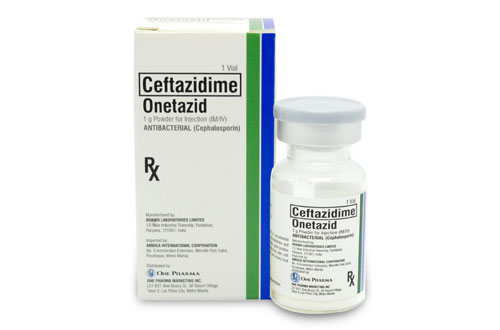
Ceftazidime
ONETAZID
Regulatory Class: Rx
Generic Name: Ceftazidime
Formulation/s: Each vial contains 1 gram Ceftazidime, USP (as pentahydrate)
Indications or Use: Infections caused by susceptible Pseudomonas aeruginosa & aerobic gram-positive organisms, including lower respiratory tract, skin, soft tissue, abdominal, bone & joints infection, urinary tract infection.
Dosage and Directions for Use: Intermittent IV/IM Adult & children ≥40 kg Broncho-pulmonary infection in cystic fibrosis 100-150 mg/kg/day every 8 hours. Max daily dose: 9 g. Febrile neutropenia, nosocomial pneumonia, bacterial meningitis, bacteraemia 2 g every 8 hrs. Bone & joint infection, complicated skin & soft tissue infection, complicated intra-abdominal infection, peritonitis associated w/ dialysis in patient on CAPD, chronic suppurative otitis media, malignant otitis externa 1-2 g every 8 hours. Complicated UTI 1-2 g every 8 hrs. or 12 hr. Pre-op prophylaxis for transurethral resection of prostate (TURP) 1 g at induction of anesthesia, & 2nd dose at catheter removal. Infant, toddler >2 month & children <40 kg Complicated Urinary Tract Infection, chronic suppurative otitis media, malignant otitis externa, bone & joint infection, complicated skin & soft tissue infection, complicated intra-abdominal infection & peritonitis associated w/ dialysis in patient on CAPD 100-150 mg/kg/day in 3 divided doses. Maximum daily dose: 6 g. Neutropenia, broncho-pulmonary infection in cystic fibrosis, bacterial meningitis, bacteraemia 150 mg/kg/day in 3 divided doses. Max daily dose: 6 g. Neonate & infant ≤2 months 25-60 mg/kg/day in 2 divided doses in most infections. Continuous infusion Febrile neutropenia, nosocomial pneumonia, broncho-pulmonary infection in cystic fibrosis, bacterial meningitis, bacteraemia, bone & joint infection, complicated skin & soft tissue infection, complicated intra-abdominal infection, peritonitis associated w/ dialysis in patient on CAPD Adult & childn ≥40 kg Loading dose: 2 g followed by 4-6 g continuous infusion every 24 hr. Infant, toddler >2 mth & childn <40 kg Loading dose: 60-100 mg/kg followed by a continuous infusion 100-200 mg/kg/day. Maximum daily dose: 6 g.
Contraindication: : Hypersensitivity to penicillin or cephalosporins.
Special Precaution: Hypersensitivity to penicillins & β-lactams. Personal or familial history of allergy e.g., bronchial asthma, rash or urticaria. Patients w/ severe renal impairment, malnutrition & those w/ general condition. Discontinue immediately if severe allergic reaction occurs. Reports of antibacterial agent-associated colitis & pseudomembranous colitis. Prolonged use may result in overgrowth of non-susceptible organisms (e.g., Enterococci, fungi). Concurrent treatment w/ high dose cephalosporin & nephrotoxic medicinal products e.g., aminoglycosides or potent diuretics (e.g., furosemide) may adversely affect renal function. Should only be used in pregnant woman if clearly needed. Caution when administered to a nursing woman. Decrease dose in elderly w/ renal impairment.
Adverse Reaction: Diarrhea, abdominal pain, vomiting, nausea; rash, urticaria, pruritus, Stevens-Johnson Syndrome ; shock; slight increase in Serum glutamic-oxaloacetic transaminase, serum glutamic pyruvic transaminase , alkaline phosphatase; slight increase in serum creatinine; headache, dizziness; leukopenia, thrombocytopenia, eosinophilia; candidiasis, vaginitis.
Interactions: Risk of nephrotoxicity w/ aminoglycosides or diuretic. Antagonism w/ chloramphenicol.
Presentation/ Packaging: Powder for injection (vial) 1 g x 1’s.
For more information, please see full product information.