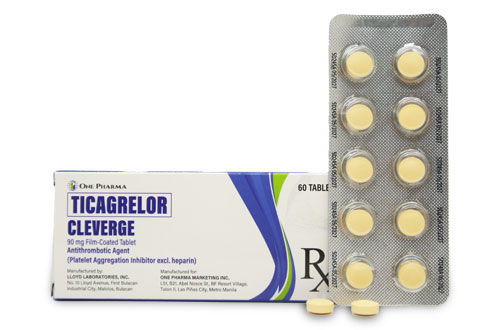
Ticagrelor
CLEVERGE
Generic Name: Ticagrelor
90 mg Film-Coated Tablet Antithrombotic Agent
FORMULATION:
Each film-coated tablet contains:
Ticagrelor ……… 90 mg
INDICATIONS:
Ticagrelor is indicated for the prevention of thrombotic events (cardiovascular death, myocardial infarction and stroke) in patients with Acute Coronary Syndromes (ACS) unstable angina, non ST elevation Myocardial Infarction (NSTEMI) or ST elevation Myocardial Infarction (STEM) including patients managed medically, and those who are managed with percutaneous coronary intervention (PCI) or coronary artery by-pass grafting (CABG).
DOSAGE AND ADMINISTRATION:
In patients with Acute Coronary Syndromes, Ticagrelor treatment should be initiated with a single 150 mg loading dose (two tablets of 90 mg) and then continued at 90 mg twice daily. Treatment is recommended for at least 2 months unless discontinuation of Ticagrelor is clinically indicated. After one year, patients initiated on 90 mg twice daily may continue treatment with 60 mg twice daily without interruption.
Patients taking Ticagrelor should also take a daily low maintenance dose of acetyl-salicylic acid (ASA) of 75-150 mg, unless specifically contraindicated. An initial loading dose of ASA is recommended for patients with ACS
Missed dose: Lapses in therapy should be avoided. A patient who misses a dose of Ticagrelor should take their next dose at its scheduled time.
Premature discontinuation: Premature discontinuation with any antiplatelet therapy, including Ticagrelor, could result in an increased risk of cardiovascular (GV) death myocardial infarction (MI), or stroke due to the patient’s underlying disease.
Switching: In patients having an ACS event, the loading dose of 180 mg should be given as soon as possible regardless of any previous antiplatelet treatment.
Physicians who, desire to switch patients, with a prior ACS event, to Ticagrelor should administer the first dose of Ticagrelor 24 hours following the last dose of the other anti-platelet medication
Administration:
For oral use, Ticagrelor can be taken with or without food.
CONTRAINDICATIONS:
Hypersensitivity to Ticagrelor or any of the excipients. Active pathological bleeding.
History of intracranial hemorrhage. Severe hepatic impairment.
WARNINGS AND PRECAUTIONS:
Bleeding risk
As with other antiplatelet agents, the use of Ticagrelor in patients at known increased risk for bleeding should be balanced against the benefit in terms of prevention of thrombotic events. If clinically indicated, Ticagrelor should be used with caution in the following patient groups: Patients with a propensity to bleed (e.g. due to recent trauma, recent surgery, active or recent gastrointestinal bleeding, or moderate hepatic Impairment). The use of Ticagrelor is contraindicated in patients with active pathological bleeding and in those with history of intracranial hemorrhage and severe hepatic impairment.
Patients with concomitant administration of medicinal products that may Increase the risk of bleeding (e.g. non-steroidal anti-inflammatory drugs (NSAIDS), oral anticoagulants, and/or fibrinolytics within 24 hours of Ticagrelor dosing).
DRUG INTERACTIONS:
Drug-Drug Interactions
Effects of Other Drugs on Ticagrelor Medicinal Products metabolized by CYP3A4
Ketoconazole (Strong CYP3A4 Inhibitors):
Co-administration of ketoconazole with Ticagrelor Increased Ticagrelor Grand AUC equal to 2,4-fold and 7.3-fold, respectively. The Cam and AUC of the active metabolite were reduced by 89% and Ba. respectively. Other strong inhibitors of CYP3A4 (clarithromycin nefazodone, ritonavir, and atazanavir) would be expected to have similar effects and should not be given concomitantly with Ticagrelor.
Diltiazem (Moderate CYP3A4 inhibitors
Co-administration of Ticagrelor and diltiazem increased the Cd Ticagrelor by 69% and AUC by 174%, and decreased the active metabolite C by 38% and AUC was unchanged. There was no effect of Ticagrelor on diltiazem plasma levels. Other moderate CYPA inhibitors (eg. amprenavir, aprepitant, erythromycin, fluconazole, and verapamil) can as well be co-administered with Ticagrelor.
Rifampin and Other CYP3A Inducers:
Co-administration of rifampin with Ticagrelor decreased Ticagrelor Cx and AUC by 73% and 86%, respectively. The C of the active metabolite was unchanged and the AUC was decreased by 46%. respectively. Other CYP3A4 inducers (eg. phenytoin, carbamazepine and phenobarbital) would be expected to decrease the exposure to Ticagrelor as wall and may result in reduced efficacy of Ticagrelor
Cyclosporine (PgP and CYP3A inhibitor)
Co-administration of cyclosporine (500 mg) with deaerator increased ticagrelor C and AUC equal to 2.3-fold and 2.8-fold, respectively. The AUC of the active metabolite was increased by 32% and C decreased by 15% in the presence of cyclosporine. There was no effect o ticagrelor on cyclosporine blood levels.
AVAILABILITY:
Alu/Clear PVC-PVC Blister Pack x 10’s (Box of 90’s)
For more information, please see full product information.