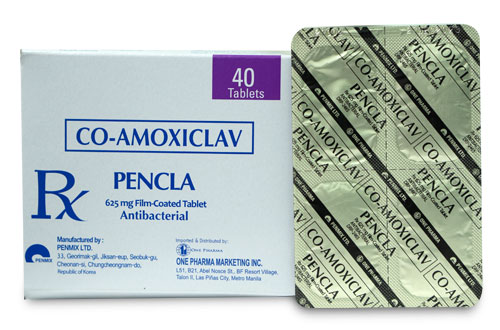
Co-amoxiclav
PENCLA
Generic Name: Co-amoxiclav
FORMULATION
Each Film-Coated tablet contains
Amoxicillin (as Trihydrate), USP ……….. 500 mg
Clavulanate Potassium (as Clavulanic Acid), EP ………. 125 mg
INDICATIONS
Co-amoxiclav is indicated for use in the treatment of infections caused by susceptible strains of microorganisms involved in the following:
Acute and chronic bronchitis, pneumonia, lung abscess, tonsillitis, sinusitis, otitis media, cystitis, urethritis, pyelonephritis, septic abortion, puerperal sepsis, chancroid, furunculosis, cellulitis, wound infection, intra-abdominal sepsis, osteomyelitis, and post-operative infections. Urinary tract infections.
Susceptible strains of microorganisms would include:
*Staphylococcus aureus, *Staphylococcus spidermidis, Streptococcus pneumoniae, Streptococcus pyogenes, Viridans group Streptococcus, *Enterococcus faecalis,
*Enterococcus faecium,Corynebacterium spp.,
*Bacillus anthracis, Listeria monocytogenes, Clostridium spp., Peptococcus spp., Peptostre ptococcus spp.
*Escherichia coli, *Proteus mirabilis, *Proteus vulgaris, “Klebsiella spp., *Salmonella spp., *Shigella spp.
, Bordetella pertussis, Yersinia enterocolitica, Gardnerella vaginalis, Brucella spp.,
*Neisseria gonorrhea,
*Moraxella catarrhalis, *Haemophilus influenzae, *Haemophilus ducreyi,
Pasteurella muttocida, Campylobacter jejuni, Vibrio Cholera, Helicobacter pytori, Legionella spp.,
*Bacteroides spp., *Fusobacterium spp.
* – including B-lactamase producing strains which are resistant to ampicillin or amoxicillin
DOSAGE AND ADMINISTRATION
The usual adult oral dose is 375 mg Film-Coated tablet three times daily or 625 mg Film-Coated tablet two times daily. For more severe infections or infections involving the respiratory tract, the dose is 625 mg Film-Coated tablet three times dally or 1g tablet two times daily, or-as prescribed by the physician.
The duration of treatment will depend on the severity of the infection but should generally be continued for at least 2 days after defervescence and disappearance of the signs and symptoms of Infection.
The usual duration of treatment unless otherwise specified is 7 to 14 days.
Co-amoxiclav tablets should be swallowed whole without chewing to be taken with sufficient amounts of liquid without regard to meals.
Dosage adjustment is recommended among patients with impaired renal function as follows; no adjustment needed for creatinine clearance of > 30 mL/min, 375 to 625 mg Film-Coated tablet dally for creatinine clearance of 10 – 30 mL/min, and 375 to 625 mg once daily for creatinine clearance of < 10 mL/min depending on the severity of the infection. The 1 g tablet of co-amoxiclav should not be used in patients with a glomerular filtration rate of <30 mL/min.
Or as prescribed by the physician.
CONTRAINDICATIONS
Co-amoxiclav is contraindicated in patients who have exhibited a history of hypersensitivity reaction to any penicillin. Co-amoxiclav is also contraindicated in patients with a history of penicillin-associated cholestatic jaundice or hepatic dysfunction.
PRECAUTIONS
Two of the 625 mg Film-Coated tablet should not be taken at one time since this double dose of clavunate is more likely to cause GIT adverse effect.
It should be administered carefully to the following patients:
- Patient with severe hepatic dysfunction.
- Patients with moderate or severe renal dysfunction. (Dost interval should be adjusted for the patients because blood concentration of the drug can be prolonged.
- Patients with a previous history of hypersensitivity to penicillins or cephems.
- Patients who or whose family have a tendency to show allergic symptoms such as bronchial asthma, rashes, uticaria, etc.
- Patients who are malnutritioned orally or who are parenterally nutritioned, the elderly patients, and patients with bad systemic condition. (Vitamin K deficiency may occur).
DRUG INTERACTION
- Probenecid decreases the renal excretion of amoxicillin. Concurrent use with Co-Amoxiclav may result in increased and prolonged blood levels of amoxicillin.
- The concurrent administration of allopurinol and ampicillin increases the incidence of rashes in patients receiving both drugs as compared to patients receiving ampicillin alone. But it is not know whether this potentiation of ampicillin rash is due to allopurinol or the yperuricemia present in these
- Co-Amoxiclav should not be co-administered with disulfiram.
- Prolongation of bleeding time and prothrombin time has been reported in some patients receiving Co-Amoxiclav. Thus this drug should be used with care in patients on anticoagulation therapy.
- Co-Amoxiclav may reduce the effect of oral contraceptives, and the caution should be given to
- Synergistic with aminoglycosides.
- Erythema multiforme with amoxicillin after MMR vaccination.
- Hypernatremia with Lithium.
ADVERSE EFFECTS
The most frequently reported adverse events are diarrhea, nausea and vomiting, skin rashes and urticaria, and vaginitis. Less frequent adverse events occurring in less than 1% of patients given co-amoxiclav include:
Hypersensitivity: Rarely urticaria and erythematous rashes may occur. Though erythematous rashes are usually mild and transient, hypersensitivity reactions may rarely be fatal. Gastrointestinal:
Dyspepsia, flatulence, glossitis, stomatitis, mucocutaneous candidiasis and pseudomembranous enterocolitis may occur. Nausea, vomiting Skin: Rarely erythema multiforme, Stevens-Johnson syndrome, Lyell’s syndrome, Quincke’s edema and dermatitis may occur. If such cases are encountered, further administration of the drug should be curtailed.
Hepatic: Occasionally elevation-of the serum transaminases may occur, however clinical hepatitis or cholestatic jaundice are rare and are reported more frequently in the elderly and in males. Liver dysfunctions are usually reversible but may be severe and very rarely, deaths have been reported but are usually associated with severe co-morbid diseases or with concomitant use of other drugs.
Renal: Rarely severe renal impairment such as acute renal failure and interstitial nephritis has been reported. Therefore, patients with suspected or potential renal problems should be carefully observed and periodically evaluated. If any abnormality is recognized, the drug should be discontinued and appropriate therapy instituted.
Hematologic: Hemolytic anemia, thrombocytopenia, eosinophilia, leucopenia, and agranulocytosis have been reported with penicillin therapy but are usually reversible on discontinuation of the drug.
Central Nervous System: Headache, agitation, anxiety, behavioral changes, confusion, convulsions, dizziness, and insomnia have been reported rarely.
AVAILABILITY
Tropical Blister Pack x 4’s (Box of 40’s)
For more information, please see full product information.