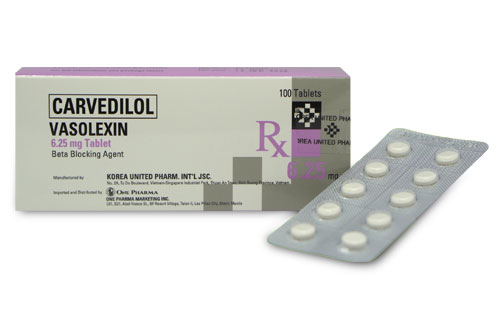
Carvedilol
VASOLEXIN
Generic Name: Carvedilol
Formulation
Each tablet contains
Carvedilol…………………6.25mg
INDICATIONS
For the treatment of hypertension; angina; and as adjunct to diuretics, digoxin, or ACE inhibitors in symptomatic chronic heart failure.
DOSAGE AND ADMINISTRATION
In hypertension, an initial dose of 12.5 mg once daily by mouth, increased after 2 days to 25 mg once daily. Altematively, an initial dose of 6.25 mg is given twice daily, increased after one to two weeks to 12.5 mg twice daily. The dose may be increased further, if necessary, at intervals of at least 2 weeks to 50 mg once daily or in divided doses. A dose of 12.5 mg once daily may be adequate for elderly patients.
In heart failure, the initial dose is 3.125 mg twice daily by mouth. It should be taken with food to reduce the risk of hypotension. If tolerated, the dose should be doubled after 2 weeks to 6.25 mg twice daily and then increased gradually, at intervals of not less than 2 weeks, to the maximum dose tolerated by the patient; this should not exceed 25 mg twice daily in patients weighing less than 85 Kg or 50 mg twice daily in patients weighing more than 85 Kg. Patients should be monitored for 2-3 hours after initiation and after each dose increase.
In case of every up-titration, physician should certainly check whether aggravation of cardiac failure and side effects by vasodilatation (e.g., descending blood pressure and dizziness) to patients, regular medical examination (e.g., renal function, weight, blood pressure and cardiac rate etc.) Occasionally, it may be necessary to lower the carvedilol dose or temporarily discontinue it.
CONTRAINDICATIONS
Patients with cardiogenic shock or those with NYHA (New York Heart Association) Class IV decompensated heart failure requiring IV inotropic support.
Patients with respiratory disease such as asthma and Chronic Obstructive Pulmonary Disease (COPD) with a bronchospastic component.
Patients with secondary hypertension.
Patients with acute pulmonary arterial embolism.
Patients who especially stimulate or block cardiac conduction such as 2nd and 3rd-degree AV block, sick-sinus syndrome and sinoatrial block.
Patients with severe bradycardia.
Patients with metabolic acidosis.
Patients taking MAO inhibitor (excluding MAO-B inhibitor).
Patients with severe hypotension (systolic blood pressure < 90 mmHg).
Patients with hypersensitivity to this drug.
Patients with hepatic impairment.
Patients with acute myocardial infarction within 4 weeks after onset of disease. Patients with sick sinus syndrome.
WARNINGS & PRECAUTIONS
Special Precautions
Patients with pheochromocytoma. Care should be taken in the administration of carvedilol to patients with diabetes mellitus, as the early signs and symptoms of acute hypoglycemia may be masked or attenuated. In congestive heart failure patients with diabetes, the use of carvedilol may be associated with worsening control of blood glucose. Therefore, regular monitoring of blood glucose is required in diabetics when carvedilol is initiated or up-titrated and hypoglycemic therapy adjusted accordingly.
Care should be taken in administration of carvedilol to patients with a history of serious hypersensitivity reactions and in those undergoing desensitization therapy as ẞ-blockers may increase both the sensitivity towards allergens and the seriousness of anaphylactic reactions. Patients with a history of psoriasis associated with B-blocker therapy should take carvedilol only after consideration of the risk-benefit ratio.
When administered to patients who have ischemic heart disease, diffuse angiosis or renal adequacy with hypotension (systolic blood pressure < 100mmHg), reversible renal dysfunction may occur. Therefore, in case of initial administration and dosage increase, renal function should be monitored. So, dosage of this drug should be reduced or discontinued in case of aggravation of renal dysfunction.
Clinical experiences of unstable angina have been few. It should be taken with caution in administering this drug to patients who have these signs or symptoms.
Since B-blocker may aggravate or stimulate symptoms of blood flow, patients with peripheral vascular disease should be careful, particularly in case of Raynaud’s disease, symptoms may be aggravated.
ADVERSE EFFECTS
Central nervous system: Occasionally, dizziness, headache and fatigue may occur. These symptoms are commonly mild and especially occur in the initial therapy. Rarely, hallucination, oviposition, depression, sleep disorder, incubus and psychosis may occur.
Cardiovascular system: Serious side effects such as high-degree bradycardia and complete AV block and cardiac failure. Cardiac function test should be regularly performed. If those symptoms appear, appropriate treatment should be instituted to reduce dose or discontinue administration. When taking this drug initially, increasing dose or suddenly standing up, blood pressure may be rarely remarkably low. Loss of consciousness may occur with symptoms such as dizziness and blurred eye vision.
Frequently, pulse frequency may be reduced and rarely, extremity frigidity may occur. These symptoms may be worse in patients with intermittent claudication, Raynaud’s disease, angina, edema and Prinzmetal’s angina.
Dizziness may frequently occur in patients with cardiac failure, edema of variant nidus and size (especially in case of dosage increase) aggravation of AV block and cardiac failure may rarely occur.
Kidney: Systemic vascular disorder may occur or renal function may be worse or rarely, renal failure may occur in patients with impaired renal function. Acute renal failure and renal abnormalities have been reported in patients with heart failure who also suffered from diffuse vascular disease and/or renal impairment.
Respiratory system: Resistance of respiratory tract may be increased. Dyspnoea and asthmatic attack, stuffy nose may rarely occur in patients with bronchospasms.
DRUG INTERACTIONS
Following concomitant administration of carvedilol and digoxin, steady-state trough concentrations of digoxin were increased by approximately 13%, 16% in hypertensive patients. Increased monitoring of digoxin levels is recommended when initiating, adjusting or discontinuing carvedilol. When given concomitantly with cardiac glycoside, cardiac rate may be remarkably low and AV conduction may be delayed.
Reaction of drugs having other activity of descending blood pressure or descending blood pressure as side effects like sedatives such as barbiturate and phenothiazine, antidepressant, vasodilator, alcohol, etc.
AVAILABILITY
In Alu/PVC Blister Pack of 10’s (Box of 100’s)
For more information, please see full product information.