

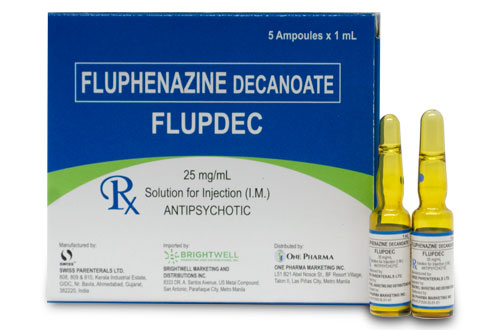
Fluphenazine Decanoate
FLUPDEC
Regulatory Class: Rx
Generic Name: Fluphenazine decanoate
Formulation/s: Each ampoule contains 25 mg of Fluphenazine decanoate, BP.
Indications or Use: For the treatment of a variety of psychiatric disorders including schizophrenia, mania, severe anxiety, and behavioral disturbances.
Dosage and Directions for Use: Usual Adult dose: 12.5 to 25 mg (0.5 – 1 mL) every 2 to 5 weeks intramuscularly. The optimal amount of the drug and frequency of administration must be determined for each patient, since dosage requirement have been found to vary with clinical circumstances as well as with individual response to the drug. Or as prescribed by the physician.
Contraindication: Phenothiazines are contraindicated in patients with suspected or established subcortical brain damage. Phenothiazine compounds should not be used in patients receiving large doses of hypnotics. Fluphenazine decanoate is not intended for use in children under 12 years of age. Fluphenazine decanoate injection is contraindicated in patients who have hypersensitivity to Fluphenazine, cross-sensitivity to Phenothiazine derivatives may occur.
Special Precaution: Extrapyramidal syndromes are particularly likely to occur. Dystonic reactions and akathisia are common and may not be recognized when they do not resemble classical parkinsonism. Dyskinesias may become irreversible. Occasionally galactorrhea, augmentation of epilepsy, epigastric pain or jaundice may occur. Fluphenazine may release stored catecholamines and therefore a risk in cases of phaeochromocytoma. 1. Pregnancy 2. Respiratory depression 3. Geriatric patients
Adverse Reaction: The side effects most frequently reported with Phenothiazine compounds are extrapyramidal symptoms including pseudoparkinsonism, dystonia, dyskinesia, akathisia, oculogyric crises, opisthotonos, and hyperreflexia. Muscle rigidity sometimes accompanied by hyperthermia has been reported following use of Fluphenazine decanoate. Most often these extrapyramidal symptoms are reversible; one can expect a higher incidence with Fluphenazine decanoate than with less potent piperazine derivatives or with straight chain Phenothiazines such as Chlorpromazine. With any given phenothiazine derivative, the incidence and severity of such reactions depend more on individual patients sensitivity than on the other factors, but dosage level and patient age are also determinants. Extra pyramidal reactions may be alarming and the patient should be usually be controlled by administration of anti-parkinsonian drugs, such as benztropine mesylate or intravenous caffeine and sodium benzoate injection and by subsequent reduction in dosage. Liver damage as manifested by cholestatic jaundice may be encountered, particularly during the first months of therapy; treatment should be discontinued if this occurs. An increase in cephalin flocculation sometimes accompanied by alterations in other liver function tests, has been reported in patients receiving the enanthate ester of Fluphenazine (a closely related compound). Although this is not a general feature of Fluphenazine, potentiation of central nervous depressants (opiates, analgesics, antihistamines, barbiturates, alcohol) may occur. The following adverse reactions have also occurred with phenothiazine derivatives; systemic lupus erythematosus-like syndrome, hypotension severe enough to cause fatal cardiac arrest, altered electrographic and electroencephalogic tracings, altered cerebrospinal fluid proteins, cerebral edema, asthma, laryngeal edema, angioneurotic edema; with long-term use skin pigmentation and lenticular and corneal opacities. Injections of Fluphenazine are extremely well tolerated, local tissue reactions occurring only rarely, angioneurotic edema; with long-term use skin pigmentation and lenticular and corneal opacities. Injections of Fluphenazine are extremely well tolerated, local tissue reactions occurring only rarely
Interactions: The possibility should be borne in mind that phenothiazines may: -Increase the CNS-depressant effects of drugs such as alcohol, general anesthetics, hypnotics, sedatives, or strong analgesics -Antagonize the action of sympathomimetic agents, including adrenaline and reverse the blood-pressure lowering effects of adrenergic-blocking agents such as guanethidine and clonidine. -Impair the anti-parkinsonian effect of L-dopa, the effect of anticonvulsants, the metabolism of tricyclic antidepressants and the control of diabetes mellitus -Increase the effects of anticoagulants and antidepressants -Interaction with lithium -Enhance the anticholinergic effects of other anticholinergic drugs, including antimuscarinic and antiparkinsonian agents. Phenothiazines may also enhance the cardiac depressant effects of quinidine, the absorption or corticosteroids and digoxin and of neuromuscular blocking agents.
Presentation/ Packaging: Type I Amber Glass Ampoule x 1 ml (Box of 5’s)
For more information, please see full product information.
